
Introduction
If your skin looks tired, uneven, or dull despite following a skincare routine, you may wonder: can vitamin C glow skin and make your complexion look brighter?
The answer is yes with an important qualification. Topical vitamin C can help improve the appearance of dullness, uneven pigmentation, and signs of photoaging, while its antioxidant activity helps defend skin from oxidative stress. Research also supports its role in collagen production and reducing excess pigment formation. However, vitamin C is not an overnight whitening treatment, and results depend on the formulation, consistency, skin condition, and daily sun protection.
For people in Pakistan, where strong sunlight and outdoor exposure can contribute to pigmentation and photoaging, a well-formulated vitamin C serum can be a useful addition to a balanced skincare routine.
So, does vitamin C brighten skin, and how should you use it if your main goal is a healthy-looking glow? Let’s look at what the science actually says.
Can Vitamin C Glow Skin?
Yes, topical vitamin C can contribute to a brighter, more radiant-looking complexion.
Vitamin C, also known as ascorbic acid, is an antioxidant. In simple terms, antioxidants help neutralize unstable molecules called free radicals that can contribute to oxidative damage in skin.
Vitamin C also has several other actions relevant to skin appearance. Research has associated topical vitamin C with:
- Brighter-looking skin
- Improvement in uneven pigmentation
- Support for collagen synthesis
- Protection against oxidative stress
- Improvement in some signs of photoaging
- A more even-looking complexion
A systematic review published in the Journal of Cosmetic Dermatology found that topical vitamin C showed benefits for pigmentation and some photoaging-related changes, although the researchers noted that more research is needed and noticeable changes may require longer-term use.
The important distinction is that vitamin C does not change your natural skin color. Instead, it may help reduce the appearance of excess pigmentation and dullness, allowing your complexion to look more even and luminous.
How Does Vitamin C Help Create a Glow?
The word “glow” can mean different things in skincare. Healthy-looking glow usually comes from a combination of even pigmentation, smoother texture, adequate hydration, and light reflecting more evenly from the skin.
Vitamin C can support several of these factors.
1. It Helps Neutralize Free Radicals
UV exposure and environmental stress can generate free radicals in the skin.
Vitamin C acts as an antioxidant that can help neutralize these reactive molecules. Dermatology reviews describe topical vitamin C as having antioxidant and photoprotective properties, although it should not be considered a replacement for sunscreen.
This is particularly relevant if your skin is regularly exposed to sunlight or environmental pollution.
2. It Supports Collagen Production
Collagen is one of the proteins responsible for the skin’s structure and firmness.
Vitamin C participates in collagen synthesis. Research has therefore investigated topical vitamin C for photoaging, fine lines, skin texture, and firmness.
Over time, supporting collagen-related processes may contribute to smoother-looking skin.
3. It Can Help With Excess Pigmentation
Another reason people use vitamin C for glowing skin is its effect on pigmentation.
Melanin is the pigment responsible for skin color. Excess melanin production or uneven distribution can contribute to dark spots and an uneven complexion.
Vitamin C has been studied for its ability to interfere with melanin formation. A systematic review of topical vitamin C found evidence of pigmentation lightening in treated areas, although the researchers emphasized limitations in the available evidence.
This means vitamin C may be useful for people concerned about:
- Post-acne marks
- Sun-related pigmentation
- Uneven skin tone
- Dull-looking complexion
- Mild discoloration
It should not, however, be marketed as a treatment that guarantees removal of melasma or other pigmentation disorders.
Does Vitamin C Brighten Skin?
Yes, vitamin C can brighten the appearance of skin, but “brightening” does not mean bleaching.
The goal of a good brightening routine is generally to improve uneven tone and reduce the appearance of excess pigmentation while maintaining healthy skin.
For example, someone with dull skin and several post-acne marks may gradually notice that their complexion looks more even after consistently using a suitable vitamin C product.
The change may be subtle at first.
Instead of expecting a dramatic transformation after several applications, look for gradual differences such as:
- Skin appearing less tired
- Dark marks becoming less noticeable
- More even-looking tone
- Improved overall radiance
- Smoother-looking texture
Clinical evidence supports the potential for pigmentation improvement, but the strength of evidence varies between formulations and studies.
What Are the Main Vitamin C Serum Benefits?
The exact results depend on the formulation and your skin, but the commonly researched vitamin C serum benefits include antioxidant protection, support for collagen synthesis, and improvement in pigmentation.
Antioxidant Support
Vitamin C can help counter oxidative stress associated with environmental exposure.
Support for Collagen
Vitamin C is involved in collagen synthesis and has therefore been investigated for photoaged skin and fine lines.
More Even-Looking Skin
Its effects on melanin production make vitamin C relevant to uneven pigmentation.
Brighter Appearance
By addressing dullness and uneven pigmentation, vitamin C may help skin look more radiant.
Support Against Photoaging
Research has found potential benefits for UV-related skin damage and photoaging, although topical vitamin C should be viewed as a supporting antioxidant—not sunscreen.
What Is the Best Vitamin C for Skin Glow?
There is no single vitamin C formula that is automatically the best vitamin C for skin glow for everyone.
The formulation matters.
L-ascorbic acid is the best-studied topical form of vitamin C, but it is also relatively unstable. Researchers have investigated both L-ascorbic acid and vitamin C derivatives because stability and skin penetration are important challenges when formulating topical vitamin C products.
When choosing a vitamin C serum, consider:
- The type of vitamin C used
- Formulation stability
- Packaging
- Your skin sensitivity
- Other active ingredients in your routine
- Whether the product is appropriate for your skin concerns
More vitamin C is not necessarily better. A highly concentrated product that irritates your skin may be less useful than a formulation you can comfortably use consistently.
How to Use Vitamin C for Glowing Skin
A simple vitamin C skincare routine does not need to contain many products.
Morning Routine
Cleanse
Use a gentle cleanser appropriate for your skin type.
Vitamin C Serum
Apply your vitamin C serum according to the product’s directions.
Moisturizer
Use a moisturizer if your skin needs additional hydration.
Sunscreen
Finish with a broad-spectrum sunscreen during the day.
This final step is especially important. Vitamin C can provide antioxidant support, but it does not replace sunscreen.
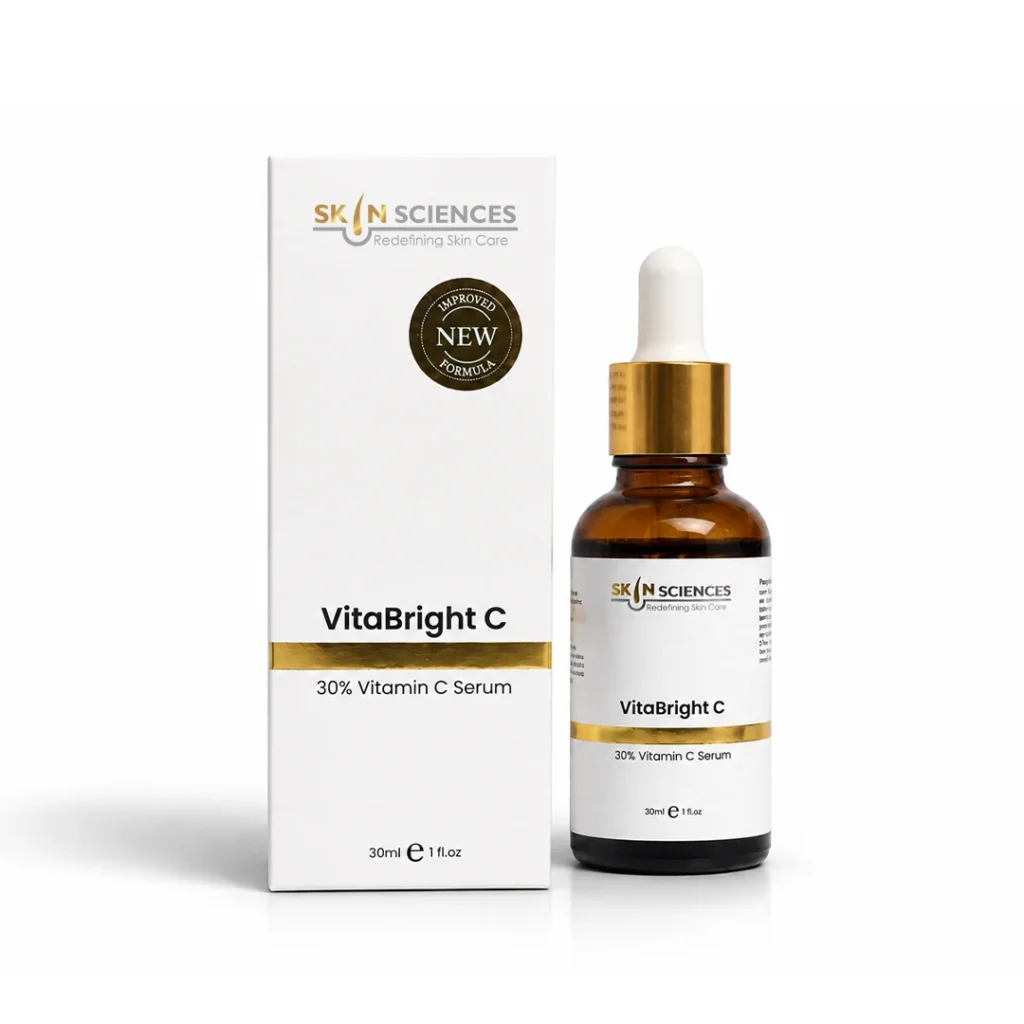
For Skin Sciences’ Vitabright C, the product page currently lists ascorbic acid among its ingredients and recommends applying a small amount to clean skin before moisturizer, with sunscreen during daytime use.
Can You Use Vitamin C at Night?
Yes.
Vitamin C is commonly used in the morning because of its antioxidant role alongside daytime photoprotection, but it can also be incorporated into an evening routine.
If you are new to vitamin C or have sensitive skin, start gradually rather than immediately adding several active ingredients at once.
What About Vitamin C and Dull Skin?
Vitamin C can be particularly useful when vitamin C dull skin searches are really about a complexion that looks tired, uneven, or lacking radiance.
However, dullness does not always have one cause.
It can be associated with:
- Dehydration
- Accumulated dead skin cells
- Excess sun exposure
- Uneven pigmentation
- Irritation
- Poor skin-barrier function
- Lack of sleep or other lifestyle factors
This is why adding vitamin C alone may not solve every cause of dull-looking skin.
A better approach is to build a basic routine around cleansing, hydration, antioxidant support, and sun protection.
Realistic Before-and-After Expectations
One of the biggest mistakes people make with skincare is expecting immediate before-and-after results.
Imagine someone beginning vitamin C because their skin looks dull and they have several post-acne marks.
Early stage
During the first couple of weeks, they may notice little visible change. The priority at this stage is tolerability and consistency.
Developing stage
With continued use, the complexion may gradually appear more even and radiant. Existing pigmentation can take considerably longer to become less noticeable.
Longer-term use
Some studies have reported improvements in photoaged skin and pigmentation over longer treatment periods. A six-month randomized study of topical 5% vitamin C reported improvements in clinical appearance and skin surface characteristics in photoaged skin.
The takeaway is simple: consistent skincare is more realistic than instant transformation.
Your results may also differ from someone else’s because pigmentation depth, skin type, sun exposure, formulation, and routine all matter.
Is Vitamin C Safe for Everyone?
Vitamin C is widely used in skincare, but topical products can still cause irritation.
Some people may experience:
- Tingling
- Redness
- Dryness
- Burning or irritation
This is more likely to be a concern when the product is strong or when multiple active ingredients are used together.
Patch Test First
If you are trying a new vitamin C serum, patch test it according to the manufacturer’s instructions.
If significant irritation develops, stop using the product.
People with persistent pigmentation, significant acne, rosacea, eczema, or unexplained skin changes may benefit from professional dermatological advice rather than trying to treat the condition exclusively with cosmetic products.
Can Vitamin C Replace Sunscreen?
No.
This is one of the most important points when discussing vitamin C and glowing skin.
Vitamin C has antioxidant and photoprotective properties, but a vitamin C serum should not be treated as a sunscreen replacement. Research describes vitamin C as a complementary photoprotective ingredient rather than a substitute for dedicated UV protection.
A practical daytime routine is:
Vitamin C → Moisturizer → Sunscreen
If pigmentation is your primary concern, consistent sun protection is particularly important because continued UV exposure can contribute to pigmentation and photoaging.
Why Skin Sciences Vitamin C Can Fit Into a Glow-Focused Routine
Skin Sciences offers Vitabright C, a vitamin C serum positioned for concerns including dullness, pigmentation, and uneven-looking skin. The current product listing identifies ascorbic acid among the ingredients and describes the formula as suitable for people seeking a brighter and more even-looking complexion.
For someone building a simple routine around radiance, the important point is not to use a long list of products.
A practical routine can remain straightforward:
Morning:
Cleanser → Skin Sciences Vitabright C → Moisturizer → Sunscreen
The product page also advises avoiding strong exfoliants on the same day, which can be a sensible approach for people who are trying to minimize irritation while introducing active skincare.
Always follow the product’s current packaging instructions because formulations and recommended usage can change.
Who May Benefit From Vitamin C?
Vitamin C may be worth considering if your main concerns include:
- Dull-looking skin
- Uneven skin tone
- Mild pigmentation
- Post-acne marks
- Early signs of photoaging
- Desire for a brighter-looking complexion
It is not necessary to use vitamin C simply because it is popular.
If your skin is already irritated, your first priority should generally be restoring tolerance and supporting the skin barrier rather than adding multiple active ingredients.
Frequently Asked Questions
1. Can vitamin C glow skin naturally?
Yes. Topical vitamin C can help skin appear brighter and more radiant by supporting antioxidant defense, collagen-related processes, and more even pigmentation. The effect is gradual and varies between individuals.
2. Does vitamin C brighten skin permanently?
Vitamin C may improve the appearance of pigmentation and dullness, but it cannot permanently prevent new pigmentation. Continued sun exposure and other factors can cause discoloration to return, so consistent skincare and sun protection remain important.
3. How long does vitamin C take to improve skin glow?
Some people notice improved radiance earlier, while pigmentation and photoaging-related changes generally take longer. Clinical research has reported measurable improvements over months rather than expecting an immediate transformation.
4. Can vitamin C be used every day?
Many vitamin C products are designed for regular use, but frequency should depend on the formulation and your skin’s tolerance. If you are new to the ingredient, introducing it gradually can help you assess how your skin responds.
5. Is vitamin C good for dull skin?
It can be. Vitamin C may help improve the appearance of dullness, uneven pigmentation, and photoaging. However, dull skin can have multiple causes, so hydration, gentle cleansing, and sun protection should also be considered.
6. Can I use vitamin C without sunscreen?
You can apply vitamin C without sunscreen, but it is not a good daytime skincare strategy if your goal is to protect against pigmentation and photoaging. Vitamin C does not provide the level of UV protection offered by sunscreen.
Featured Snippet Answer
Can vitamin C glow skin?
Yes, topical vitamin C can help skin look brighter and more radiant by supporting antioxidant protection, collagen synthesis, and more even pigmentation. Results are gradual, and consistent use alongside moisturizer and daily sunscreen is important for maintaining healthy-looking skin.
Final Verdict:
So, can vitamin C glow skin? Yes but think of it as a long-term skincare ingredient rather than an instant glow solution.
Vitamin C can support antioxidant defense, collagen synthesis, and a more even-looking complexion. Research also suggests benefits for pigmentation and photoaging, although the evidence varies between formulations and more research is still needed.
The most effective approach is simple: choose a well-formulated product, introduce it according to your skin’s tolerance, moisturize when needed, and never skip daytime sunscreen.
If you are looking for a vitamin C serum to add to a glow-focused routine, Skin Sciences Vitabright C is one option to explore for dullness and uneven-looking skin. Always check the current ingredient list and usage directions before starting a new product.